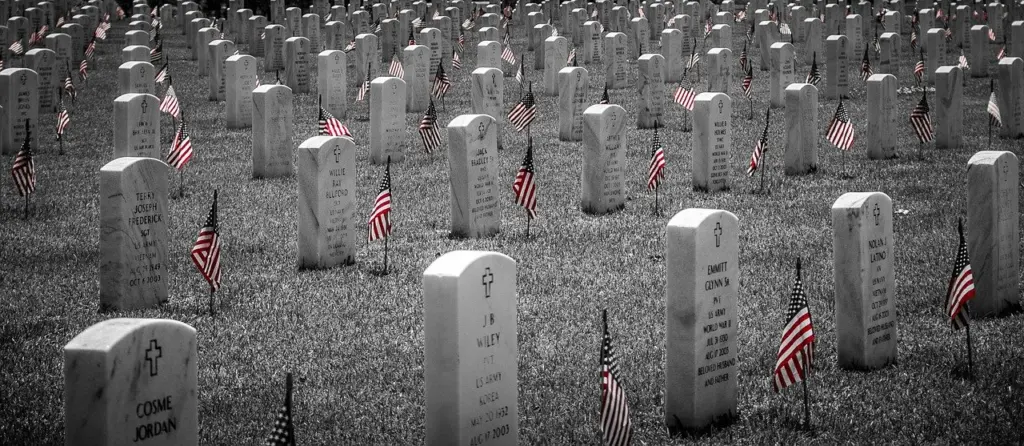
For veterans day poems you can share freely, start with In Flanders Fields by John McCrae: the Academy of American Poets states it is in the public domain. Check that note before using any other poem.
This page is an ordered selection, not a ranking. It covers what to read, what to say aloud and how to word a card. If you are planning more than a reading, our guide to ways to thank veterans covers other gestures.
How to choose a poem or tribute
The right words depend on the room and on whether you may legally reproduce them. Judge each option against these criteria before you print it in a programme or write it in a card.
- Free to share. Prefer a poem whose publisher states it is in the public domain, as the Academy of American Poets does on its page for In Flanders Fields. A poem merely being easy to find online does not settle that question.
- Fit for the occasion. A remembrance poem suits a moment for the fallen. A card to a living veteran usually needs a line of personal thanks beside it.
- Easy to read aloud. Choose text with a steady rhythm and plain images, because listeners hear it once and cannot reread it.
- Full text available. You should be able to read the complete poem from a reliable page, not a half-remembered excerpt.
Poems and readings to consider
These options are listed in order of how securely their sharing status is established, not by quality. The first has a clear public-domain statement, while the others need a quick check or are your own work.
In Flanders Fields by John McCrae
In Flanders Fields is the most reliable single choice for a Veterans Day reading. A Wikisource edition of McCrae’s collection records that it first appeared in Punch on 8 December 1915. The Dixon Center describes it as written in 1915, during the First World War, by the Canadian officer and surgeon John McCrae. The Academy of American Poets lists McCrae’s dates as 1872 to 1918 and publishes the full text, which opens with the line “In Flanders fields the poppies blow”.
It suits ceremonies, programmes and printed cards, because its public-domain status is stated by the publisher. It is a poem about the fallen, so for an audience of living veterans, follow it with a sentence that thanks the people in the room. Its setting is the First World War, so introduce it briefly rather than assuming everyone knows the context.

Poems written by veterans
Poetry has long been a way for service members to process what they lived through. A Vietnam Veterans of America feature on veteran verse puts it simply: “So many of us wrote poetry. Poured out our souls.” Reading a veteran’s own words at an event can land harder than a classic, because the audience hears a first-hand voice.
The limit is rights. A modern poem by a veteran is not free to reproduce just because it is moving. Ask the author or publisher, or confirm a public-domain statement, before printing it. If you cannot confirm, read it with the author’s permission or choose another text.
Your own short verse or card line
For a card, a few plain lines of your own are often better than a borrowed poem. You own the words, so there is nothing to check, and the message can name the person and a specific thing you are grateful for. This suits relatives, neighbours and classrooms. It does not suit a formal ceremony where a recognised poem carries the weight, so pair it with a public-domain reading there.
Poems for fallen soldiers and fitting words
Remembrance verse works when it is simple and does not try to explain loss. The Dixon Center writes that in remembrance poems “the worst thing we can do is to forget”. That is a useful test for any words you choose: they should keep the fallen present, not turn the moment into a speech about something else.
Appropriate wording is plain and respectful. Name the sacrifice, say that the person or people are remembered, and stop. Avoid slogans and avoid guessing at how a family feels. The same source notes that the families of fallen service members are given the honorific “Gold Star”, so use that term for those families, and use it carefully and only where it applies.
A reading is not the only form of tribute. The Dixon Center also suggests planting a remembrance tree or flowers with your family, which gives children a quiet task while the words are spoken. If your event leans toward the fallen specifically, the history of memorial day explains how that observance began and can inform what you say.
Writing a short tribute speech
A good Veterans Day speech can be built around a poem. Reading a public-domain text means you can print it in the programme without asking anyone, and it gives the speaker a natural opening and close. Follow these steps in order.

- Open with the poem line. Read the opening line or a short passage, such as “In Flanders fields the poppies blow”, then pause.
- Say who you are honouring. Name the group in the room, or a veteran with their permission. Specific beats general.
- Add a concrete detail. Use something true that you know, such as a task, a place or a small habit. Do not borrow stories you cannot support.
- Say thank you directly. Address the veterans plainly. Keep the wording simple.
- Close by returning to the poem. End on the last line you read or on a moment of silence.
Keep the speech short enough that the poem remains the centre. If you are also planning remarks for another occasion, what is armed forces day covers a different observance that may call for its own words.
Comparing the options
| Option | Sharing status | Best for | Planning use |
|---|---|---|---|
| In Flanders Fields | Stated to be in the public domain by the Academy of American Poets | Ceremonies, programmes, printed cards | Safe to print and read; add thanks for living veterans |
| Poems written by veterans | Varies; confirm each one | Personal readings with a first-hand voice | Get permission or a public-domain statement first |
| Your own short verse | Yours to share | Cards, classrooms, family gatherings | Name the person and one thing you are grateful for |
The public-domain statement comes from the Academy of American Poets, and the point about veterans writing poetry comes from the Vietnam Veterans of America.
Frequently asked questions
What are good poems to read on Veterans Day?
In Flanders Fields is a dependable choice, with its full text available from the Academy of American Poets. Poems by veterans also work well when you have permission to use them.
Which poems are in the public domain and free to share?
The Academy of American Poets states that In Flanders Fields is in the public domain. For any other poem, look for a similar statement on the publisher’s page before printing or reproducing it.
What words are appropriate for honoring fallen soldiers?
Plain, respectful wording that says the fallen are remembered works best. Use the term Gold Star for the families of fallen service members, and avoid guessing at a family’s feelings.
Who wrote In Flanders Fields, and when?
John McCrae, a Canadian officer and surgeon, wrote it in 1915. It first appeared in Punch on 8 December 1915.