| Effect | What the evidence supports | Planning use |
|---|---|---|
| Stress relief | Experts report that focusing on someone other than yourself interrupts usual tension-producing patterns. | Choose a role where you work directly with or for other people, not only solitary tasks. |
| Physical health | Studies report that volunteers rate their physical health better than non-volunteers do. | Treat this as a possible extra, not a reason to skip medical care. |
| Longevity | A longitudinal aging study found lower mortality rates among volunteers after controlling for age, gender and health. | Relevant to older adults deciding whether to commit to a regular role. |
| Social networks | Volunteers build stronger social networks that act as a buffer to reduce stress. | Favour team-based roles and repeat shifts with the same group. |
| Experience and career | Volunteers gain professional experience and can test out a career. | Use a short placement to try a field before committing to it. |
| Youth opportunities | Volunteering builds skills and can lead to scholarship opportunities for young volunteers. | Keep a clear record of what a young volunteer did and when. |
| Older volunteers | Reported benefits are especially pronounced in volunteers aged 60 and over. | A strong case for retirees to add a regular volunteer commitment. |
| Value of time | The estimated value of a volunteer’s time in California is $26.87 per hour (CNCS basis). | Use it to describe the worth of donated time in California, not as a universal rate. |
Findings above come from the UC San Diego service resources page and the Utah UServe blog on volunteering.
The benefits of volunteering are strongest for stress, social connection and experience, and the research mostly shows association, not proven cause. Choose a role with regular contact with other people and a task you can sustain.
If you want to organise an effort rather than join one, how to start a donation drive is a practical place to begin.
What adult volunteers can realistically expect
For adults, the best-supported gains are lower stress, a wider social circle and, for some, better self-rated health. These are real reported effects, but they describe groups of people, not a guarantee for any one volunteer.
Stress and mental health
Mental health is the benefit most often claimed for volunteering. The explanation given by UC San Diego’s service resources is specific: when you focus on someone other than yourself, it interrupts your usual tension-producing patterns. That describes stress relief, which is narrower than a cure for anxiety or depression.
The practical consequence is that the task matters. A role that keeps you occupied with other people or a clear job suits this effect better than one that leaves you alone with your worries.
Physical health and longevity
Utah’s UServe blog reports that volunteers describe their physical health as better than non-volunteers do. It also cites a longitudinal aging study in which volunteers had lower mortality rates than people who did not volunteer, after controlling for age, gender and health.
Controlling for those factors makes the result harder to explain by them alone. Even so, healthier people may also be more likely to volunteer, so treat these findings as encouraging, not as a prescription. Volunteering is a sensible addition to a healthy routine and a poor substitute for one.
Social connection
The same Utah page says volunteers build stronger social networks that act as a buffer to reduce stress. This is where social skills come in: working beside others toward a shared task gives repeated, low-pressure practice at cooperating, which is hard to get from a single one-off event.
If connection is your goal, commit to a recurring shift. Seeing the same people each week does more for a network than a single busy day.
Older volunteers
The reported benefits are especially pronounced for volunteers aged 60 and over, according to the Utah page. Retirees weighing how to fill newly open time have a good reason to choose a regular role with other people rather than occasional solo tasks.
Skills, experience and career testing
Volunteering gives people a low-risk way to gain professional experience and test out a career, as UC San Diego’s resources put it. The supported claim is experience and a chance to try a field. A job offer is not part of it.
- Career changers: pick a nonprofit role close to the field you are curious about, so the experience is relevant and you can see whether the day-to-day work suits you.
- People returning to work: a steady volunteer commitment shows recent, practical activity and gives you current examples to talk about.
- Anyone undecided: a short trial role costs little and can rule a direction in or out.
Students
For students, the supported benefits are skill building and, according to Utah’s UServe page, a possible route to scholarship opportunities for young volunteers. Evidence that volunteering directly lifts grades or admissions chances is not part of what these public pages report, so do not rely on it.
Choose a cause you will stick with. A sustained commitment gives more to describe, and more to learn from, than several one-off appearances. Since scholarship opportunities are a possible outcome, keeping a tidy record matters, and how to log volunteer hours explains how to document service hours properly.
What kids gain from volunteering
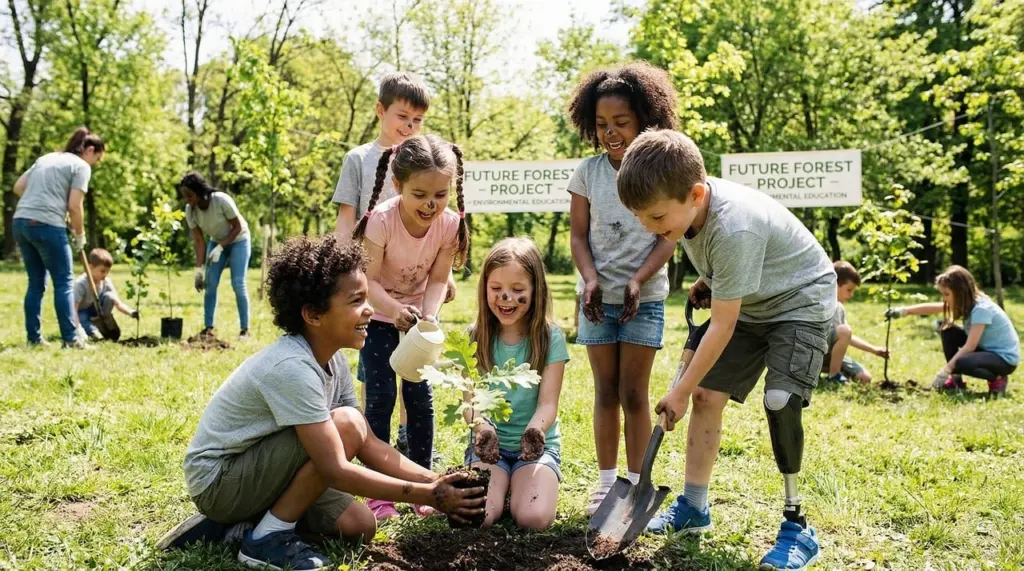
Children and teenagers mainly gain skills and, for older young volunteers, access to scholarship opportunities, according to Utah’s UServe blog. Teamwork also appears among the benefits described by UC San Diego, which points to uniting people from diverse backgrounds around a common goal.

Empathy and confidence are often named as outcomes for younger children. They are plausible, but they are not measured in the public pages cited here, so present them as hopes rather than results.
For parents and teachers, the decision is about fit. Choose tasks that a child can finish and see the result of, in a group where adults are present. Shared, concrete tasks give the teamwork benefit room to develop.
Community service projects and nonprofits
A community service project turns individual time into something visible. UC San Diego lists examples such as beach and park cleanups, and notes that volunteers support families, schools, youth and parks.

Working with a local nonprofit organization also teaches something practical. The UC San Diego page says volunteers learn about the functions and operation of government through local nonprofit agencies, so a placement can double as a lesson in how local services are funded and run.
Volunteer time has a measurable economic value too. The estimated value of a volunteer’s time in California is $26.87 per hour on the CNCS basis, as stated by UC San Diego. That is a California estimate, so use it carefully if you report service hours for a project elsewhere.
Why volunteering seems to work
Three mechanisms appear in the public material, and each one points to a design choice. Attention shifts away from yourself, which interrupts tension-producing patterns. Social networks grow, and they act as a buffer against stress. A shared goal unites people from different backgrounds, which builds camaraderie and teamwork.
None of these mechanisms depends on the cause being large. They depend on regular, social, purposeful activity, which is why a modest weekly shift can matter more than an occasional heroic effort.
Choosing a role that delivers the benefits
- For stress relief: pick work that puts you in contact with the people you are helping or the team beside you.
- For connection: sign up for a repeating shift with the same group, not a single event.
- For experience: ask the organisation what you will actually do, and whether it matches the field you want to try.
- For seasonal or one-off energy: holiday volunteer ideas suit people who want a short, defined commitment before building a regular habit.
Frequently asked questions
Is it proven that volunteering causes better health?
No. The reported findings compare volunteers with non-volunteers. The aging study controlled for age, gender and health and still found lower mortality for volunteers, but that does not settle cause and effect.
Can volunteering replace mental health care?
No. The supported effect is stress reduction when attention turns to others, and that is a useful supplement to care rather than a replacement for it.
Is the dollar value of volunteer time the same everywhere?
Not necessarily. The figure of $26.87 per hour is an estimate for California, according to UC San Diego, so check the figure that applies to your own state before reporting it.
Where can a student start?
Community cleanups at beaches and parks are a straightforward entry point, and local nonprofits that support families, schools and youth also take volunteers. Choose one you can return to regularly.